February 18, 2026·6 min read
Otto Dotzauer and Stickerei Vogel
In the Vogtland today, the number of workshops producing authentic Plauener Spitze can be counted on one hand. Where hundreds of embroidery firms once operated in and around Plauen, a small number of family-run enterprises now carry the entire weight of the tradition. Among them, two names represent the continuity and quality that define the craft at its best: Stickerei Vogel and Otto Dotzauer.
Stickerei Vogel: five generations of thread
The Vogel family has been producing Plauen lace for five generations. Their workshop, operating under the trade name StiVoTex, maintains the complete production cycle within its own facilities: pattern design, machine embroidery, chemical dissolving, and hand-finishing. This vertical integration is not merely an operational choice. It is a commitment to controlling every variable that affects the quality of the finished piece.
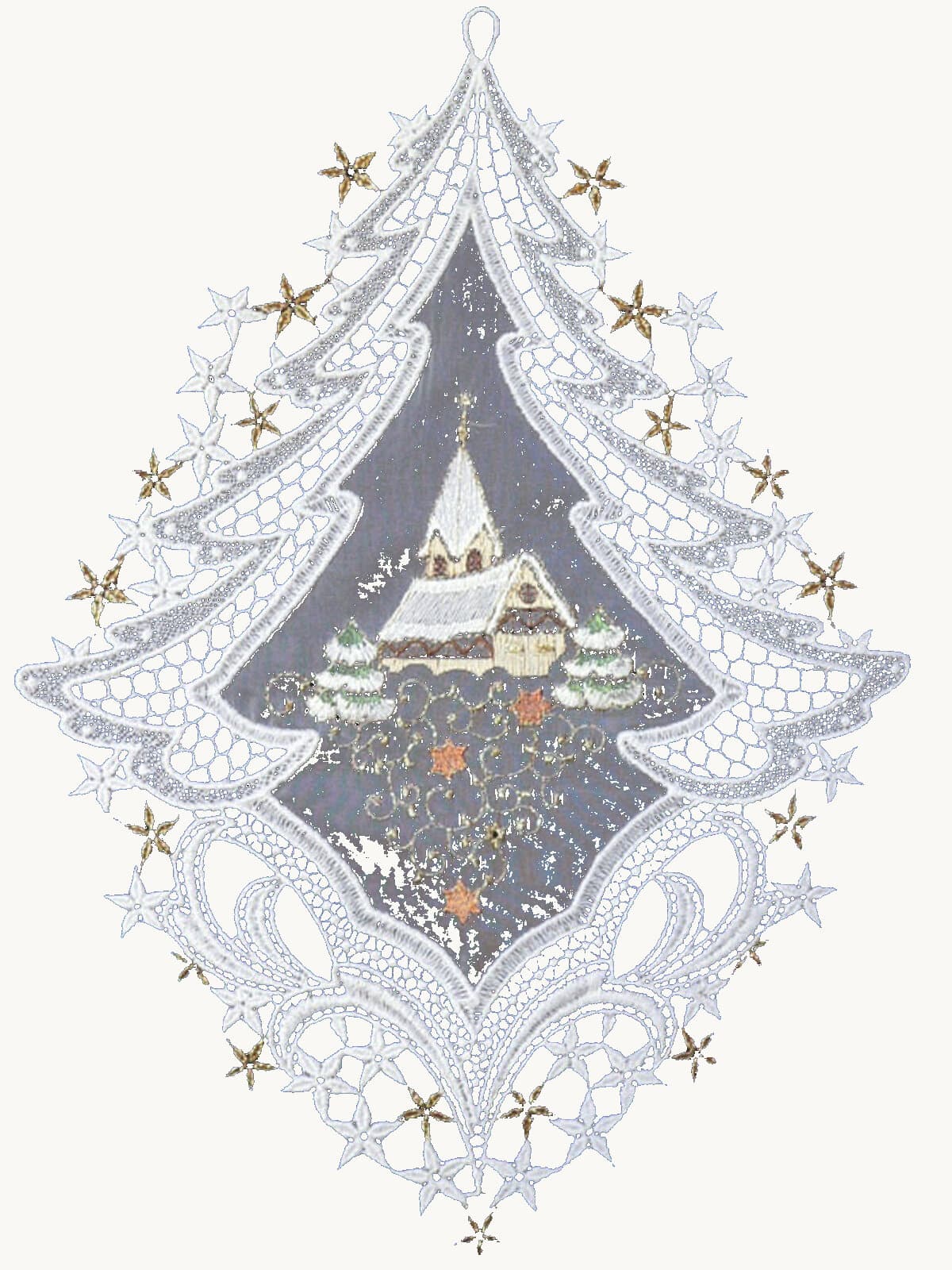
The Vogel workshop's range encompasses the full breadth of Plauener Spitze tradition. Embroidered tablecloths and runners in white and ecru. Lace window pictures depicting Christmas scenes, nature motifs, and village life. Decorative frames in the shapes of bells, hearts, diamonds, and lanterns. Seasonal hangings and ornaments. Each category demands its own set of skills and finishing techniques, and the workshop's ability to produce across the entire range reflects the depth of accumulated knowledge within the family.
What distinguishes Stickerei Vogel is an approach to production that prioritizes craft over volume. Each piece receives the same patient attention regardless of its size or commercial value. A small tree ornament is finished with the same care as a large tablecloth. The workshop produces in quantities that allow this standard to be maintained, accepting that limiting output is the cost of preserving quality.
The transparency of their production is something the Vogel family emphasizes. Visitors to the workshop can observe the embroidery machines in operation, watch the dissolving and finishing processes, and see firsthand the handwork that goes into every piece. This openness is not a marketing gesture. It is an expression of confidence in the integrity of the work.
Otto Dotzauer: refined tradition
The Otto Dotzauer workshop represents another lineage of Vogtland lace-making, with a particular reputation for refined table linens and decorative pieces. Where some workshops have broadened their range to include accessories and novelty items, Dotzauer has maintained a focused collection that emphasizes the classical strengths of Plauener Spitze.
The Dotzauer name carries weight in the Vogtland. Their pieces are recognized by collectors and connoisseurs of fine lace for their consistent quality, their attention to traditional pattern vocabularies, and the precision of their finishing work. A Dotzauer tablecloth or window picture represents the highest standards of the craft as it has been practiced in the region for over a century.
Like Stickerei Vogel, the Dotzauer workshop operates with an awareness that each piece they produce is measured against the full history of Plauener Spitze. The standards are not arbitrary. They are inherited, the accumulated expectations of generations of lace-makers who understood that reputation, once lost, cannot be rebuilt.
The burden of being the last
There is a weight that comes with being among the final practitioners of a tradition. The workshops that continue to produce authentic Plauener Spitze are not simply businesses. They are repositories of knowledge, guardians of patterns that exist nowhere else, keepers of finishing techniques that were learned by observation and practice rather than from manuals.
The economic pressures are real. Mass-produced lace from regions with lower labor costs is available at a fraction of the price. Consumer awareness of the distinction between authentic Plauener Spitze and generic machine-made lace is limited. The market for fine handcraft, while loyal, is not large.
Yet the families persist. They persist because the craft is not something they do. It is something they are. The Vogel family's identity is woven into five generations of lace-making. The Dotzauer name is synonymous with a standard of quality that cannot be separated from the family that maintains it. To cease production would be to sever a thread that connects them to their own history.
What they preserve
The significance of these workshops extends beyond the commercial value of their products. They preserve a complete system of knowledge: the design principles that govern pattern-making, the technical understanding of how thread and machine interact, the finishing skills that transform raw embroidery into finished lace, and the quality standards that distinguish authentic Plauener Spitze from imitation.
This knowledge is embodied, held in the hands and eyes of trained artisans rather than codified in textbooks. Each generation adds to it, refining techniques, adapting to new materials, solving problems that arise from the natural variation of thread and fabric. But the foundation remains the same, handed down through the workshops of the Vogtland in an unbroken chain that stretches back to the earliest days of machine embroidery in Plauen.
When one purchases a piece from Stickerei Vogel or Otto Dotzauer, one acquires not merely a decorative object but an artifact of this living tradition, a tangible connection to the hands that made it and the generations of knowledge that guided those hands.
Continue reading
March 20, 2026·7 min read
The Plauener Spitze tradition
Five centuries of lace-making in Saxony's Vogtland region, from the earliest hand-worked threads to the refined embroidery that defines Plauen lace today.
March 6, 2026·7 min read
How Plauen lace is made
From the initial design drawing to the Schiffchen shuttle loom and the chemical dissolving bath, the process behind every piece of Plauener Spitze.