March 1, 2026·7 min read
How Plauen lace is made
Plauen lace occupies a singular position among European lace traditions. It is neither purely hand-made nor purely machine-made. The process that produces it — a sequence of machine embroidery, chemical dissolving, and meticulous hand-finishing — has remained fundamentally unchanged since the late nineteenth century.
The pattern
Every piece of Plauen lace begins with a pattern. In the workshops of the Vogtland, many patterns have been in continuous use for decades. Some trace their origins to the earliest years of a family workshop. New patterns are still designed by hand, a process that requires an intimate understanding of how thread, tension, and fabric interact at the scale of individual stitches.
The pattern dictates every aspect of the finished piece: the density of the embroidery, the placement of open areas that will become the lace’s negative space, the colors and weights of thread to be used. A well-drawn pattern is the foundation upon which everything else rests.
Embroidery on dissolvable fabric
The embroidery is carried out on a specialized machine, using a base fabric that will later be dissolved. This base — typically a chemical-lace fabric or a water-soluble substrate — serves as a temporary scaffold. The embroidery machine follows the pattern, laying down thousands of stitches in multiple thread colors and weights to build up the design.
The skill of the machine operator is not to be underestimated. Setting thread tension, monitoring stitch quality, and managing color changes across a complex design requires years of training. A single misalignment can ruin an entire panel.
The dissolving bath
Once embroidery is complete, the fabric panel enters the dissolving bath. The chemical solution breaks down the base fabric entirely, leaving behind only the embroidered threads. What emerges from the bath is the lace itself — a freestanding structure of interlocking stitches with no fabric behind it.
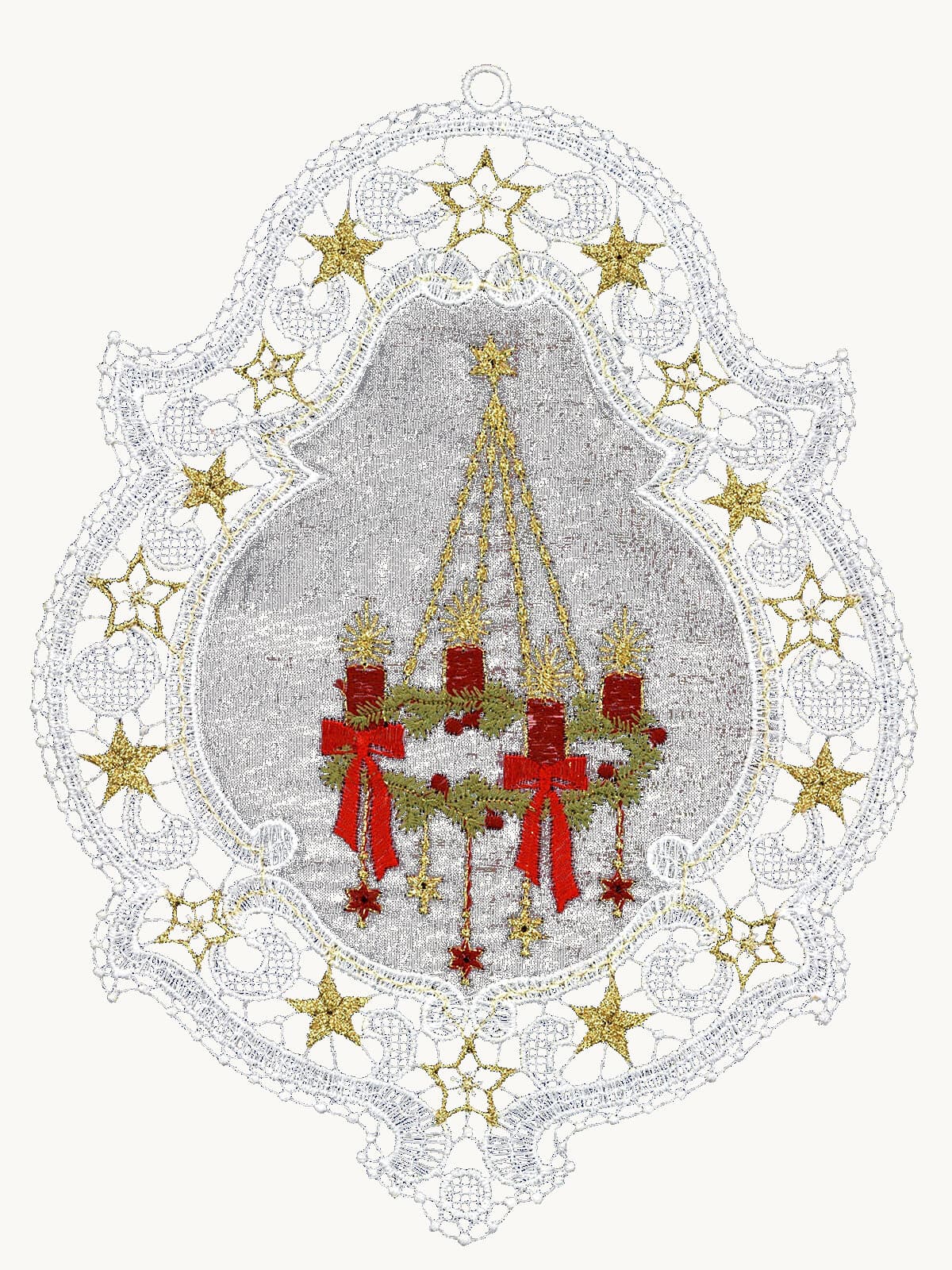
This moment of dissolution is what gives Plauen lace its distinctive character. The open areas between embroidered motifs become transparent, allowing light to pass through. It is this quality that makes lace window pictures so effective: the interplay of thread and light creates a visual depth that no printed or woven fabric can achieve.
Hand-finishing
The work that follows the dissolving bath is entirely manual. Each piece must be rinsed, stretched, and shaped while still damp. Excess threads are trimmed. The lace is starched to varying degrees depending on its intended use — a window picture receives enough starch to hold its shape against a pane of glass, while a tablecloth receives a lighter treatment to maintain its drape.
Experienced finishers inspect every piece by hand, checking for broken threads, uneven tension, and imperfections in the stitch pattern. This inspection is not cursory. A single flawed section can mean reworking or discarding an entire piece. The standard is absolute: nothing leaves the workshop that does not meet the family’s criteria for quality.
Through the transparency of our production, one can be convinced of the uniqueness of these precious items, crafted with much handwork.
Materials
The threads used in Plauener Spitze are predominantly fine cotton and viscose, selected for their tensile strength, their sheen under light, and their ability to hold intricate shapes after starching. Some pieces incorporate metallic threads — gold and silver — for decorative accents, particularly in Christmas window pictures and seasonal ornaments.
The base fabrics on which the lace is displayed include Swiss voile and organza, chosen for their transparency and the way they complement the lace’s open structure. The relationship between lace and base fabric is considered carefully: the fabric should recede, allowing the embroidery to be the sole visual element.